The question every ADU plumbing quote eventually raises
Somewhere in the plumbing conversation for a garage conversion, the question comes up: does the new unit need its own water heater, or can it run off the one already serving the main house? The honest answer is that it depends on distance, capacity, and how the unit will actually be used, and it’s worth understanding before your plumber shows up with a number.
Sharing the existing water heater
If your garage sits close to the main house’s water heater, sharing it is sometimes possible, especially for a JADU with light kitchen and bathroom use rather than a full ADU meant for a separate household. The limiting factors are pipe run length and the water heater’s recovery capacity. A long run from an existing tank to a detached or far-corner garage means a longer wait for hot water at the new fixtures and more heat loss along the way, which shows up as both an inconvenience and a slightly higher utility bill. A tank sized for a three-bedroom house that now also has to serve a tenant’s shower, kitchen sink, and laundry at the same time as the main house can run short during simultaneous peak use, mornings especially.
Why most full ADU conversions get their own unit
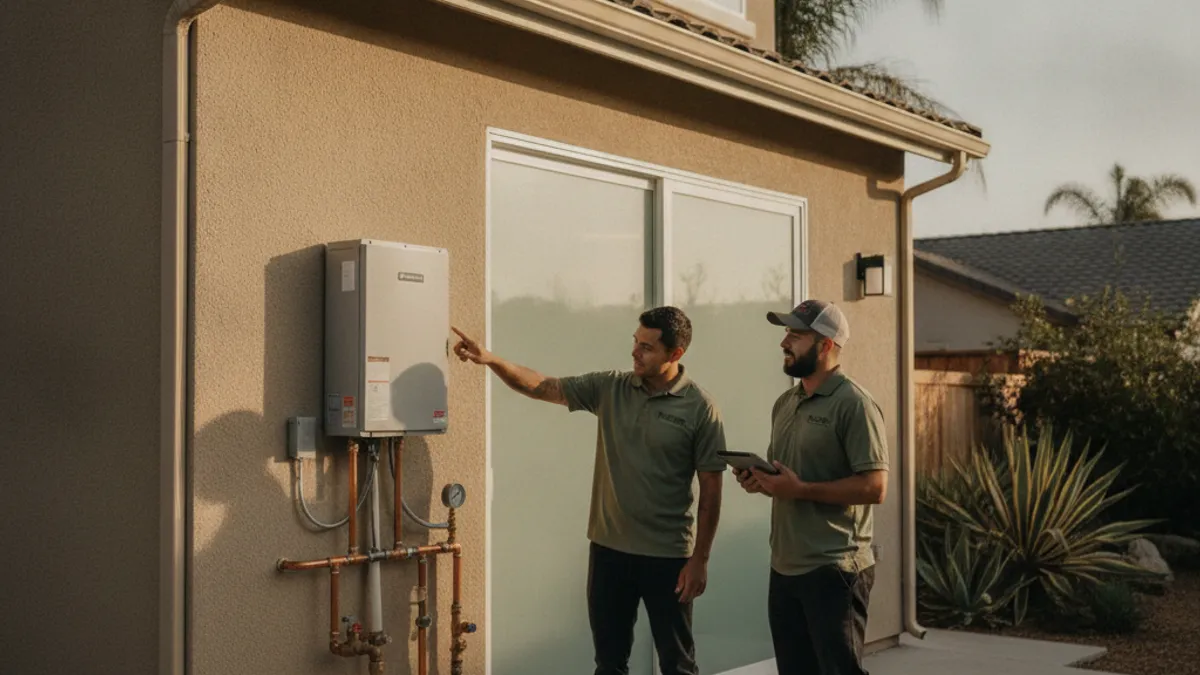
For a full ADU meant to function as an independent household, a dedicated water heater is the more common choice, and increasingly the practical one given how tight most garage floor plans already are. A tankless unit is the usual pick for this situation, since it doesn’t need the floor space a tank does and can mount on an exterior or interior wall. A gas tankless unit installed for an ADU typically runs $3,000-$5,000 in San Diego, including venting and a dedicated gas line if one isn’t already nearby. An electric tankless unit costs less upfront, often $1,500-$3,000 installed, but needs a large dedicated electrical circuit that some older homes’ panels can’t support without an upgrade.
A small electric tank, 20 to 30 gallons, is a lower-cost option for a JADU or studio conversion with modest hot water demand, typically $1,200-$2,200 installed, though it doesn’t keep pace with a full ADU’s simultaneous shower-and-laundry demand as well as a tankless unit does.
What actually decides the choice
Distance from the main house’s water heater. Under roughly 30-40 feet of pipe run, sharing is often workable. Beyond that, the wait time and heat loss make a dedicated unit the better call regardless of unit type.
How the space will be used. A rental ADU with its own tenant needs reliable, independent hot water, since a shared system means one household’s heavy shower morning affects the other’s. A JADU used by a family member, with more predictable, coordinated water use, has more flexibility to share.
Available space and utilities. A detached garage without existing gas service is a strong argument for electric tankless or a small electric tank rather than running new gas line, which adds both cost and a separate permit step.
Existing electrical capacity. Electric tankless units draw significant amperage, sometimes requiring two 40-50 amp double-pole breakers. Confirm your panel has room before assuming electric tankless is the cheaper path once you account for a possible panel upgrade.
A mild-climate advantage most cost guides don’t mention
Tankless water heaters in colder climates often need freeze protection, insulated enclosures, or interior-only placement to avoid a frozen unit during winter. San Diego’s mild temperatures largely remove that concern, which opens up more flexible mounting locations, including an exterior wall directly outside the ADU, that would need extra protection and cost in a harsher climate. That flexibility can simplify the plumber’s routing and shorten the distance between the unit and the fixtures it serves, which helps hot water arrive faster at the tap.
Heat pump water heaters as a third option
Beyond tankless and standard tank units, a heat pump water heater is worth a look for an ADU specifically because it draws less electricity than a standard electric tank to heat the same volume of water, an advantage if your ADU is running on a limited subpanel shared with the main house. The tradeoff is size: heat pump water heaters need more room volume around them to work efficiently than a slim tankless unit does, which can be a tight fit in a compact converted garage utility closet. It’s a reasonable option to discuss with your plumber if your layout has the space for it.
Where this fits in the bigger plumbing picture
Water heater choice is one piece of a larger rough-in scope that includes supply lines, drain lines, and venting for the new bathroom and kitchen fixtures. It’s worth deciding on a water heater approach early in design, since a dedicated tankless unit’s location affects where the plumber runs supply lines and where the electrician or gas fitter needs access.
Can a garage conversion ADU share the house’s existing water heater?
Sometimes, if the garage is close to the main water heater and the ADU’s hot water demand is modest, such as a JADU rather than a full rental unit. Longer pipe runs and heavier simultaneous use both push toward a dedicated unit.
Is tankless better than a tank for an ADU?
Tankless saves floor space, which matters in a converted garage, and provides continuous hot water rather than running out during a long shower. A small tank costs less upfront and has simpler maintenance, which can be the better tradeoff for lighter, JADU-level use.
Does an ADU water heater need its own permit?
Water heater installation, tankless or tank, typically requires a plumbing permit, and a gas tankless unit needs a permit covering the venting and any new gas line. Confirm the current permit scope for your specific project with San Diego Development Services before work begins.
To plan the plumbing rough-in for your garage conversion, including water heater placement, see our plumbing for ADU page or call (858) 400-4935.
Garage Convert SD connects San Diego homeowners with experienced, insured crews for garage-to-ADU conversions. Call (858) 400-4935 for a free consultation.