A garage-to-ADU project needs more than someone who handles basic remodeling. It combines several trades under one permitted residential project. If you’re comparing permitted garage conversion specialists, a Class B general building contractor is usually the right prime-contract fit.
Why a conversion is multi-trade work
A garage becomes an ADU only after it meets dwelling standards. The permit review covers applicable building, health and safety, fire, and energy requirements. The finished unit also needs complete independent living facilities.
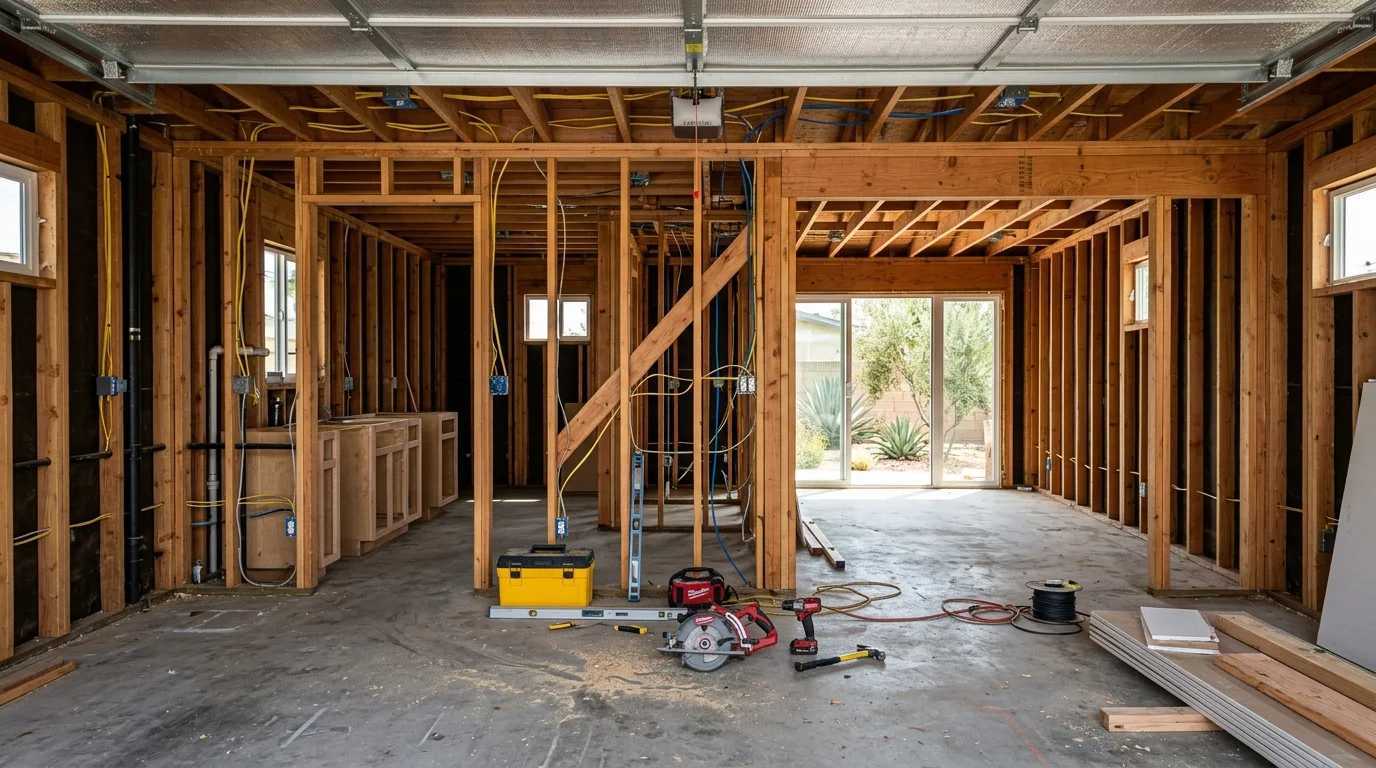
That scope commonly reaches framing, electrical, plumbing, HVAC, drywall, and finish work. Adding a kitchen and bathroom can bring several trades into one compact space. Closing the garage-door opening also changes the exterior wall. Sleeping areas must meet current residential emergency-egress requirements, though the exact requirements belong in the approved plans.
The existing slab, ceiling, walls, and utility routes shape the job. A detached garage may need different utility planning than an attached garage. A conversion can also expose old work that wasn’t shown on existing plans. The contractor should identify those conditions before assigning a firm scope.
Every City of San Diego ADU or JADU requires a building permit. The city’s ADU program page explains its local path. Other cities use their own building departments. Unincorporated communities such as Lakeside, Ramona, Spring Valley, and Fallbrook go through San Diego County.
That jurisdiction difference matters. A contractor experienced in Chula Vista isn’t automatically familiar with a coastal Carlsbad parcel. Ask which local department will review your address. Then ask who prepares plans, responds to corrections, and coordinates the trades.
Our full ADU conversion service connects homeowners with licensed independent professionals for this multi-trade work. Garage Convert SD itself doesn’t design, permit, or build the unit.
What a Class B general building licence covers
California Business and Professions Code §7057 defines a Class B general building contractor around structures involving at least two unrelated building trades or crafts. A garage-to-ADU conversion fits that structure because the prime contract usually brings several trades together.
That doesn’t mean every contractor with a Class B licence is an ADU specialist. It means the classification can fit the overall multi-trade contract. Experience with garage conversions, permit plans, utility coordination, and residential code remains a separate question.
The contract’s actual scope matters too. A Class B contractor can’t simply take any prime contract involving one isolated specialty trade. Section 7057 limits that situation unless the contractor holds the appropriate classification or subcontracts that work. For a genuine garage-to-ADU conversion, the contract should describe the connected trades and the complete residential result.
Start by asking who will hold the prime contract. Get the contractor’s legal business name and licence number before treating a proposal as serious. The name on the proposal should make sense beside the information returned by the state’s licence check.
The licence classification is one checkpoint, not the whole hiring decision. A strong candidate should also explain how the proposed layout becomes a permitted dwelling. That explanation should connect the plans, trade scopes, inspections, and written payment schedule.
For a broader screening process, use our guide to hiring a garage conversion contractor in San Diego. It helps you compare proposals without treating the lowest total as the only deciding factor.
When specialty licences get subcontracted
A Class B contractor often manages the full conversion while specialty contractors handle portions of the job. Electrical, plumbing, and HVAC work may be assigned to appropriately classified subcontractors. The prime contractor may also hold an additional classification.
Ask for that structure in writing. You should know which company holds your contract and which businesses will complete regulated specialty work. Don’t settle for “we have a guy” as the full explanation.
The prime contractor should be able to describe each trade’s scope. Plumbing may include the kitchen, bathroom, water heating, and sewer connection. Electrical work may include new circuits, lighting, receptacles, and service coordination. HVAC work should match the approved design for the converted space.
This coordination matters because trades depend on one another. Framing affects utility routes. Plumbing locations affect the slab and cabinets. Electrical rough-in must happen before walls are closed. Plan changes can affect several scopes at once.
California law gives a Class B licensee defined ways to handle this work. The contractor may perform work covered by a held classification or subcontract the appropriate classification. Ask which route applies to your project.
You don’t need to accept vague allowances for major unfinished decisions. Ask whether the proposal includes the complete ADU scope shown on the plans. If a trade isn’t included, the exclusion should be easy to find.
Also ask who handles corrections involving several trades. Permit comments don’t always stay inside one box. A wall change can affect structural, electrical, and mechanical sheets. One person should own that coordination under the contract.
Checking a licence yourself in two minutes
Ask every bidder for the exact licence number and legal business name. Don’t rely on a logo, truck decal, or screenshot. Enter the number yourself through the official CSLB licence check.
Confirm that the result matches the company offering the contract. Review the classification shown for that licence. For a multi-trade garage-to-ADU prime contract, look for the Class B general building classification discussed above. If another classification appears, ask the bidder to explain how the proposed contract fits it.
Repeat the check for named specialty subcontractors when their information becomes available. Save the results with your bid documents. Then check again before signing, since your decision should rest on the official record rather than an old image.
A licence number should also appear consistently across the proposal and contract. A mismatch needs an explanation before money changes hands. Don’t assume two similar company names refer to the same legal contractor.
The permit belongs to the property and project, not the marketing language. Ask whose name will appear as the contractor on the application. Also confirm which building department has jurisdiction over your address.
San Diego County contains incorporated cities and unincorporated communities. The correct permit desk changes with the parcel. Coastal properties can also introduce separate local review issues. The contractor should identify the jurisdiction from the address instead of guessing from the neighborhood name.
This short check doesn’t replace a full comparison. It removes one avoidable uncertainty before you spend time reviewing design choices and schedules.
What a licence does not tell you
A valid classification doesn’t prove that a contractor writes clear scopes. It doesn’t tell you whether the proposal covers your intended kitchen, bathroom, insulation, HVAC, or garage-door infill. It also doesn’t show how carefully the contractor studied the existing structure.
Ask for a proposal tied to the plans or a clearly described preliminary scope. Look for specific responsibilities. Who measures the garage? Who prepares permit drawings? Who coordinates engineering if it becomes necessary? Who responds to plan-check comments? Who schedules inspections?
The licence also doesn’t settle local permitting questions. A City of San Diego parcel may follow a different path from Oceanside, Coronado, or unincorporated San Diego County. Coastal-zone requirements and parking rules can differ. The bidder should avoid blanket answers that treat every San Diego County address alike.
California’s ADU guidance provides the statewide framework. Local building departments still review project-specific plans. State law requires applicable conversion projects to meet residential building, health and safety, fire, and energy standards.
A licence doesn’t replace a complete home improvement contract either. California Business and Professions Code §7159 governs home improvement contracts exceeding $500. The written contract must address the price, project description, significant materials, payment schedule, approximate dates, and required disclosures.
The statutory downpayment language is exact: “THE DOWNPAYMENT MAY NOT EXCEED $1,000 OR 10 PERCENT OF THE CONTRACT PRICE, WHICHEVER IS LESS.” Extra work and change orders become part of the contract once prepared in writing and signed.
Questions that separate the real bids
Good questions make competing bids easier to compare. Ask each contractor the same ones and keep the answers beside the proposal.
- Which licence number and legal business name will appear on my contract?
- Who will hold the prime contract for the complete conversion?
- Which specialty trades will you subcontract?
- Which building department has jurisdiction over this address?
- Does the scope create a full ADU or another type of living space?
- Who prepares the permit plans and handles plan-check corrections?
- What existing-garage conditions aren’t included in this proposal?
- Does the scope cover the kitchen, bathroom, HVAC, electrical, and finishes?
- Who coordinates inspections and required corrections?
- Which selections or materials remain undecided?
- How will extra work and change orders be documented?
- What events can change the approximate start or completion dates?
- What work is expressly excluded?
Listen for address-specific answers. “San Diego County” isn’t a permit jurisdiction by itself. The parcel may sit inside an incorporated city or an unincorporated area. A bidder should identify the correct authority before describing the permit path.
Watch for proposals that mix design assumptions with firm construction promises. A garage can hide slab, framing, or utility conditions that plans must address. The contractor should state what has been inspected and what remains unknown.
Compare the scopes line by line. One bid may include permit coordination and finish materials. Another may exclude both. A lower total doesn’t tell you whether the proposals describe the same result.
Garage Convert SD is a referral service. We match homeowners with licensed, independent local pros, and the homeowner contracts with the selected professional directly. Our about page explains that relationship before you request a match.
When to call us
A permitted garage-to-ADU conversion needs a licensed professional when the scope combines structural work, electrical, plumbing, HVAC, and permit coordination. Call (858) 400-4935. The number plays a recording-consent notice and records both sides. If nobody picks up, use the contact form.