A JADU conversion in San Diego can carry an owner-occupancy condition, but the bathroom layout matters. It also requires a recorded deed restriction and must sit inside a single-family residence. A detached garage takes a different permit path.
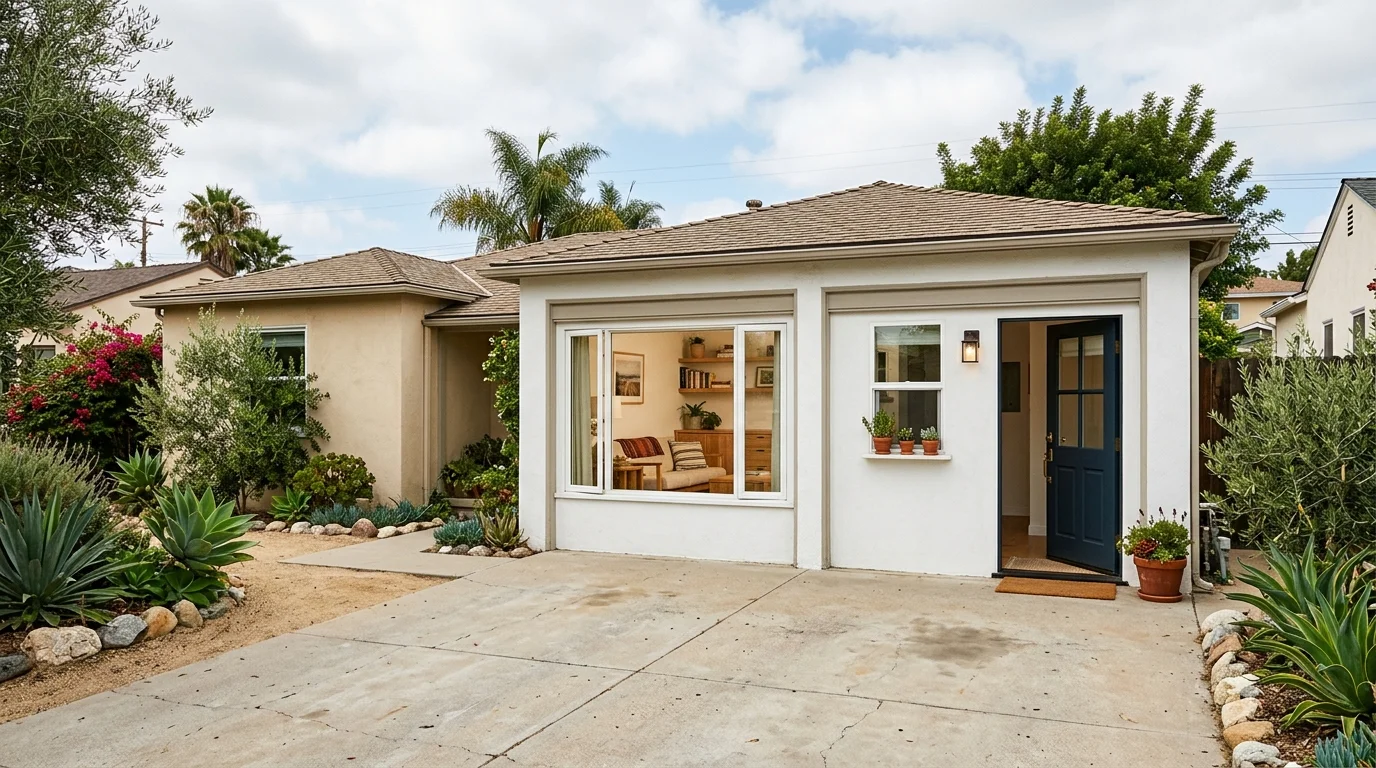
What makes a unit a JADU and not an ADU
California defines a junior accessory dwelling unit by its location and design. A JADU must be built within the walls of a proposed or existing single-family residence. For this rule, an attached garage counts as part of that residence.
That makes an attached garage a possible JADU location. A detached garage doesn’t qualify, even when it sits only a few feet away. Converting that detached structure into a dwelling requires the full ADU path instead.
The City of San Diego lists JADUs from 150 to 500 square feet. The unit needs its own entrance and an efficiency kitchen. State law describes that kitchen as a cooking facility with appliances, plus a reasonably sized food-preparation counter and storage cabinets.
A JADU doesn’t always need a private bathroom. It may share sanitation facilities with the main house. That choice becomes important because it affects the owner-occupancy rule.
A full ADU is different. It has complete independent living facilities and can be created within an attached or detached garage. The City lists ADUs from 150 to 1,200 square feet, although the property and project type still shape the permitted design.
The California HCD ADU resources explain the statewide framework. The City of San Diego ADU program covers projects inside city limits. Properties in Chula Vista, Oceanside, or unincorporated San Diego County go through their respective permitting authorities.
Our ADU versus JADU guide offers a broader comparison of these two permit paths.
The recorded deed restriction, in plain terms
A JADU requires a recorded deed restriction. The restriction runs with the land, so it remains tied to the property after an ownership change.
Its central rule is straightforward. The JADU can’t be sold separately from the single-family residence. It stays part of the same property rather than becoming an independently saleable unit.
The restriction doesn’t mean the homeowner loses ownership of the converted area. It defines how the JADU relates to the main residence. The two spaces may function separately in daily life, but they can’t be divided into separate real estate sales.
The City of San Diego identifies DS-202A as its JADU agreement form. Confirm the current form and recording steps with Development Services before relying on a downloaded copy. Forms and intake procedures can change.
This paperwork deserves attention early in the design process. A homeowner may begin with a simple attached-garage conversion idea, then learn that the JADU classification carries conditions a full ADU doesn’t. Choosing the product first helps the designer prepare the correct plans.
A permit is required for every ADU and JADU in the City of San Diego. The deed restriction isn’t a substitute for building review. The converted space must still meet the building, health and safety, fire, and energy standards that apply to dwellings.
Garage Convert SD doesn’t prepare or record legal documents. We connect homeowners with licensed, independent local professionals who can plan the physical conversion. Your contractor and the applicable building department can identify the project documents needed for that specific parcel.
Shared bathroom versus separate bathroom
California law uses the phrase “sanitation facilities.” In practical planning, the key question is whether the JADU shares those facilities with the main residence or has separate ones.
When a JADU shares sanitation facilities with the primary structure, owner occupancy is required. The owner may live in either the main residence or the JADU. The rule doesn’t require the owner to occupy one specific side.
When the JADU has separate sanitation facilities, current state law doesn’t require owner occupancy. That distinction makes the bathroom decision more than a matter of privacy or convenience.
A shared arrangement may reduce the work inside the garage. A separate bathroom adds another part of the project for the designer and contractor to address. Plumbing location, electrical needs, ventilation, wall layout, and the existing slab can all affect the scope. Those factors should be evaluated at the property rather than guessed from a listing photo.
Don’t assume an existing laundry sink or nearby bathroom answers the legal question. Ask the applicable building department how it will classify the proposed facilities. Inside the City of San Diego, that means Development Services. A property in an unincorporated community goes through San Diego County instead.
The bathroom decision should appear consistently across the floor plan, permit application, and JADU agreement. A licensed local professional can help turn the intended arrangement into a buildable plan.
Our junior ADU conversion service explains how we match homeowners with professionals for attached-garage projects. The contractor performs the work and contracts directly with the homeowner.
Why an ADU has no owner-occupancy rule at all
A full ADU follows a different owner-occupancy rule. California Government Code section 66315 prevents local agencies from imposing an owner-occupant requirement on ADUs.
That means a homeowner doesn’t have to live in either the primary residence or the ADU solely because an ADU was created. This rule applies to ADUs, not every JADU arrangement.
The distinction matters when comparing an attached-garage JADU with a full ADU. Both may create a small living unit. They don’t carry identical legal conditions.
A full ADU must include complete independent living facilities. A JADU may share sanitation facilities and uses an efficiency kitchen. The JADU also carries its recorded deed restriction. If it shares sanitation facilities, it carries the owner-occupancy condition described above.
A homeowner shouldn’t choose based only on the shorter name or apparent floor area. Start with how the space will function. Consider the garage’s connection to the house, whether the bathroom will be shared, and whether independent living facilities are planned.
The physical location creates a firm dividing line. A detached garage can’t become a JADU because it isn’t contained within the single-family residence. It may qualify for conversion into a full ADU instead.
Neither label removes the permit requirement. The City of San Diego requires a building permit for every ADU and JADU. The permit review also covers residential building, health and safety, fire, and energy standards.
Confirm current requirements with the building department before committing to plans. State rules create the framework, while the property’s jurisdiction handles the application.
The 30-day rental condition cities may add
No owner-occupancy requirement doesn’t mean an ADU has unrestricted rental use. State law allows a local agency to require rental terms of 30 days or longer.
That authority is separate from owner occupancy. One rule addresses whether the owner must live on the property. The other addresses how long a tenant may rent the unit.
Don’t treat a garage ADU as an automatic short-term rental option. The local jurisdiction may restrict rentals to terms of at least 30 days. Other property documents may also need review, but don’t assume their wording without checking the recorded documents themselves.
For a City of San Diego parcel, ask Development Services which current conditions apply to the proposed unit. If the project is elsewhere in the county, contact that city or the County department responsible for the address. Don’t rely on requirements quoted for a neighboring city.
JADUs need separate attention because their deed restriction and owner-occupancy rules differ. A shared-bathroom JADU requires the owner to occupy either the primary home or the JADU. A JADU with separate sanitation facilities doesn’t carry that state owner-occupancy requirement.
These distinctions should be settled before final plans. Changing from a shared bathroom to a private one can change the physical scope. Changing from a JADU to a full ADU changes the permit category and required facilities.
Ask the building department to confirm its current rental conditions in writing. That gives the designer and homeowner a clear source instead of relying on an old checklist or a rule from another jurisdiction.
Which product fits your garage
Start with the garage’s relationship to the house. An attached garage may support either a JADU or full ADU plan. A detached garage can’t become a JADU, so the dwelling path is a full ADU conversion.
Next, decide how independent the space should be. A JADU needs an efficiency kitchen and separate entrance, but it may share sanitation facilities. A full ADU needs complete independent living facilities.
Then consider occupancy. A shared-sanitation JADU requires the owner to live in either the JADU or main residence. A separate-sanitation JADU doesn’t carry that state requirement. A full ADU has no owner-occupancy requirement under state law, although a city may require rentals of 30 days or longer.
The existing garage also shapes the construction scope. The team may need to address the garage door opening, utilities, plumbing, insulation, interior walls, and residential code compliance. A site visit and permit review are better guides than a standard package.
Costs depend on the chosen product and the existing structure. A private bathroom, relocated plumbing, service upgrades, and structural changes can expand the work. Our JADU conversion cost guide focuses on those scope drivers without presenting an unsupported project price.
Before signing a contract, check the professional’s record through the CSLB license check. Garage Convert SD is a referral service. The homeowner contracts with and pays the independent professional directly.
The right choice is the category that matches the structure, intended facilities, and occupancy plan. Confirm that choice with the permitting authority before the design is finalized.
When to call us
Call when an attached-garage JADU or full garage ADU needs design, permit, plumbing, electrical, or multi-trade construction help. We’ll match you with a licensed, independent local pro, but Garage Convert SD doesn’t perform the work itself.
Call (858) 400-4935. The number plays a recording-consent notice and records both sides. If nobody picks up, use the contact form.