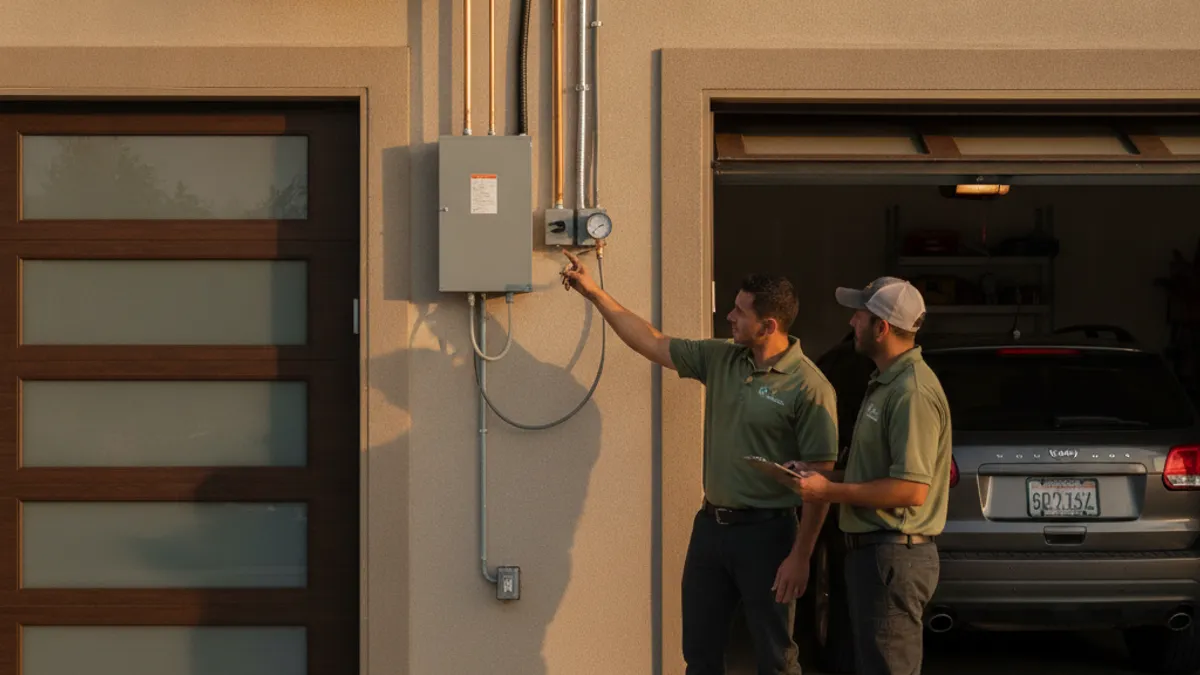
Not every conversion has to give up the whole garage
Most garage conversion content assumes the whole structure is getting converted, but a two-car garage doesn’t have to become an all-or-nothing decision. A partial conversion, turning one bay into living space while keeping the other as a working garage, is a real option that comes up often enough in San Diego’s tract-home neighborhoods, where the standard two-car garage is common, to deserve its own explanation.
What the construction actually involves
A partial conversion starts with a new interior wall, framed and insulated, dividing the garage down the middle where the two bays meet. That wall becomes the new boundary between the converted living space and the remaining parking bay, and it needs to meet the same fire-rating and insulation standards as any other wall separating living space from a garage. Depending on layout, that dividing wall sometimes runs down the middle or is offset to give the converted space a bit more width than the remaining parking bay, particularly if the conversion is meant for a bedroom or office that benefits from a wider footprint.
The remaining bay then typically gets a smaller garage door to replace the full two-car door. This site does not publish a single-car door and header install price. The licensed pro prices the new opening from the existing header and the door size you need.
Why homeowners choose partial over full conversion
The most common driver is simple: the household still needs covered parking, whether for a vehicle, a boat, or storage that doesn’t fit anywhere else on the property, and giving that up entirely isn’t worth the extra square footage a full conversion would provide. It’s also a way to add meaningful living space, a bedroom, an office, a small studio, without triggering the full scope and cost of a JADU or ADU conversion with a kitchen and bathroom, since a partial conversion into a single room is often a simpler permit path than a full independent unit.
What it costs relative to a full conversion
A partial bay is a smaller footprint than converting the whole garage, but it still needs a fire-rated dividing wall, insulation, HVAC, and electrical. Compare it to the published bedroom and office bands on the cost hub, not to an invented partial-only total. The licensed pro’s written proposal is the price.
Parking requirements are a site-specific question
Depending on your property and existing site conditions, converting even part of a garage can raise questions about required off-street parking, particularly for homes where the garage was the only covered or dedicated parking on the lot. Current parking rules for garage conversions, including any replacement parking requirements, vary by jurisdiction, by whether the conversion includes an ADU or JADU, and by state law that has changed multiple times in recent years. Confirm what applies to your specific property and project with San Diego Development Services before finalizing your plans. A partial conversion that keeps one bay as parking is sometimes exactly the strategy homeowners use to sidestep a replacement parking question entirely, but don’t assume that without confirming it for your situation.
HVAC and utilities for a partial conversion
Extending HVAC into just one bay of a two-car garage is usually simpler and cheaper than conditioning the full structure, since a single-zone mini-split sized for the smaller converted footprint is often enough on its own. Electrical work follows a similar pattern: the converted bay needs its own circuits for lighting, outlets, and any HVAC equipment, while the remaining parking bay typically keeps its existing outlets and garage door opener circuit largely as-is. Because the systems are smaller in scope than a full conversion, the mechanical portion of a partial conversion budget usually lands toward the lower end of what a comparable full conversion would cost.
Design considerations specific to a shared structure
Sound and temperature separation between the new living space and the working garage bay matter more here than in a full conversion, since a running vehicle, a workshop, or stored chemicals sit on the other side of a single wall from a bedroom or office. A well-insulated, properly sealed dividing wall with attention to sound transmission is worth the modest extra cost over a minimal code-only wall.
Do I need a permit for a partial garage conversion?
Yes. Even converting part of a garage into habitable space requires a building permit covering the new wall, insulation, electrical, and HVAC work. Confirm the specific scope and any parking-related requirements with your local building department.
Can I convert one bay now and the second bay later?
In many cases, yes, though it depends on how the dividing wall and utilities are designed initially. Planning for a possible future second-phase conversion during the first project’s design can make a later expansion simpler and less disruptive.
What happens to my garage door opener and existing storage if I only convert half?
The remaining bay keeps a standard garage door opener sized for the new, smaller door, and typically retains overhead storage racks or shelving along the dividing wall, since that structure is already in place and doesn’t need to move for the conversion to work as intended.
Is a partial conversion cheaper than converting the whole garage?
The per-square-foot cost is similar, but the total project cost is lower simply because less square footage is being converted. You’re also keeping a functional parking bay, which has its own value if covered parking matters for your household.
To plan a partial conversion that keeps working parking on your property, see our garage door replacement with wall page or call (858) 400-4935.
Garage Convert SD connects San Diego homeowners with experienced, insured crews for full and partial garage conversions. Call (858) 400-4935 to get matched with a crew that does this work.